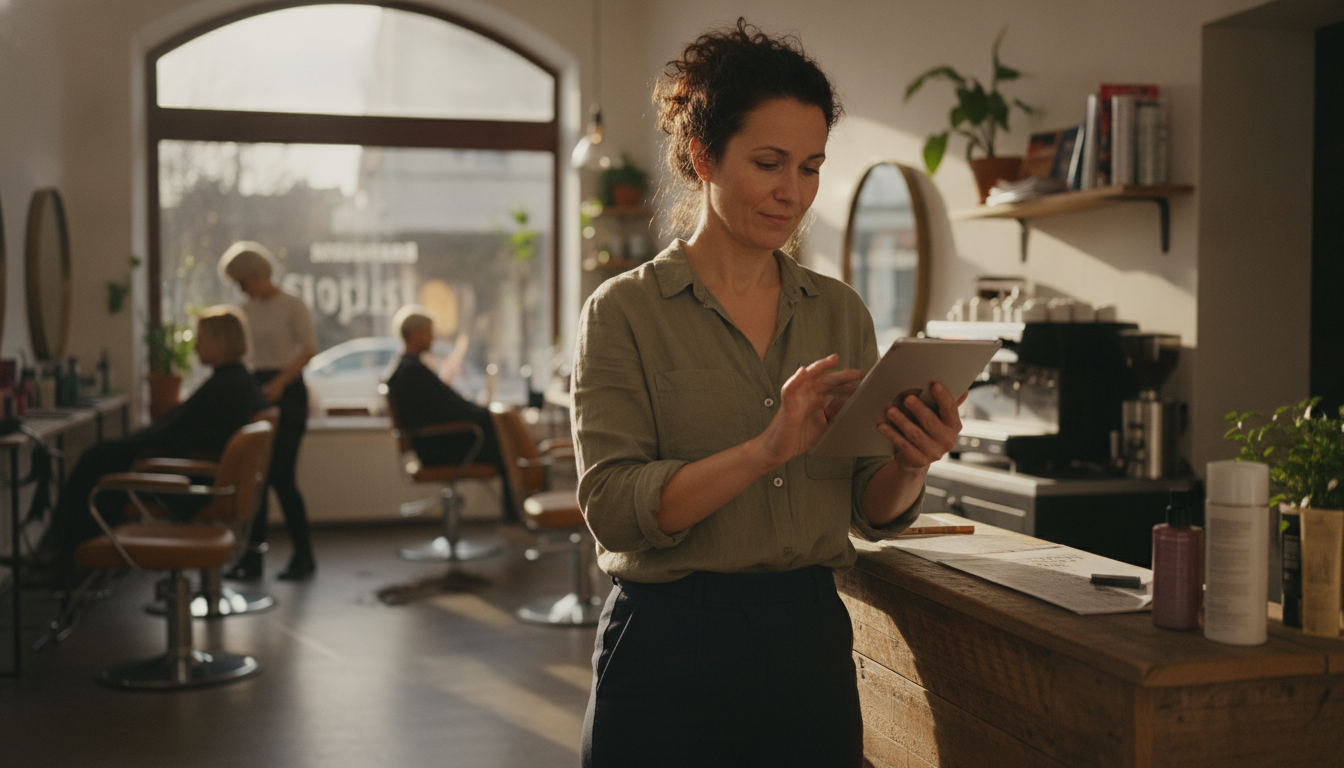
Nadia runs a hair salon in Lyon with eight chairs, a loyal core clientele, and a phone she used to pick up at 10pm to write Instagram captions. She was consistent - three posts a week, the occasional story, a monthly promotion she assembled in Canva on Sunday afternoons. She was also exhausted. And her repeat-visit rate, the number she actually cared about, had been flat for seven months. In January, she stopped writing captions entirely. By the end of week eight, repeat visits were up 94% against the same two-month window the year before. What changed was not her brand, her prices, or the quality of her cuts. What changed was the infrastructure running underneath her marketing.
The Real Problem Was Never the Content
Most salon owners, cafe owners, and boutique retailers who struggle with marketing share the same root issue: they are executing tactics that were designed for media companies, not for businesses where the owner is also the practitioner. Nadia was spending roughly four hours a week on content - writing, scheduling, replying to comments - and those four hours were producing posts that her existing followers saw, mostly, and that moved nobody to book. The content was not bad. It was disconnected. There was no follow-up loop. There was no system timed to the actual moment a customer was most likely to return. She was broadcasting to an audience that had already bought from her, using a channel that rewarded novelty over relevance.
What the First Four Weeks Actually Looked Like
Nadia did not flip a switch. The first two weeks were about moving content production off her plate. Using Rulrr's AI Content Studio, she fed in her service menu, her brand tone, and her top three post formats from the previous six months. The system generated a four-week content calendar - captions, post angles, stories - that she reviewed in under 20 minutes on a Monday morning and approved or lightly edited. Posting became automated from there. The time saving was real: those four weekly hours collapsed to under 30 minutes. But the time saving was not the story.
- Week 1-2: Content calendar built and scheduled for the full month - Nadia approved everything in two Monday sessions totalling 45 minutes
- Week 2: First automated follow-up message triggered 48 hours after each appointment, personalised by service type
- Week 3: A 30-day re-engagement sequence activated for clients who had not returned since November
- Week 4 check: 11 re-bookings directly attributed to the follow-up sequence - none of those clients had been reached by organic social
- Week 4 vs prior year same period: repeat visit rate up 41% - still climbing
The Touchpoint Nobody Was Covering
The 94% figure did not come from better captions. It came from the follow-up layer that most small businesses never build because they are too busy building the content layer. Nadia's booking data was connected into Rulrr's automated workflows, which meant the system could identify a client's typical return interval - say, every six weeks for a colour treatment - and trigger a personalised re-engagement message just before that window closed. For lapsed clients, the 30-day re-engagement sequence sent a message that referenced their last service by name and offered a soft booking prompt, not a discount. For new clients who had visited once, the 48-hour follow-up asked a simple question about their experience and included a single-tap rebooking link.
I had been posting for two years thinking that was my marketing. I did not realise I had built an audience and then done nothing with it. The follow-up system is what my posting was always missing.
Week Eight: The Numbers and What They Mean
By week eight, Nadia's repeat visit rate had moved from 34% of monthly bookings to 66%. Revenue per client, tracked across the two-month window, was up because returning clients spend more and book add-ons more readily than first-timers. Her social following had grown modestly - around 11% - which she correctly identified as a secondary outcome. The primary outcome was that the customers who had already paid her once were coming back at nearly twice the rate. That is the distinction that matters: social content, when disconnected from a retention loop, is mostly brand maintenance. Social content plus a timed, personalised follow-up workflow is a revenue system.

The Three Shifts That Drive the Result
First, content stops being hand-made and starts being systematised - approved in batches, posted consistently, and calibrated to your actual audience rather than a generic best-practice calendar. Second, the follow-up layer activates: every completed transaction triggers a timed, relevant message rather than silence. Third, lapsed customers stop being invisible - their absence from your booking window becomes a signal the system reads and acts on before they are gone permanently. None of these shifts require a marketing team. They require a workflow that runs itself once it is set up.
How to Replicate This Before the End of the Month
- Audit your current content time: log every minute you spend on captions, scheduling, and post ideas for one week - most owners are shocked by the number
- Identify your average return interval: look at your last 60 days of booking data and calculate how long your typical client waits between visits - this number defines when your follow-up should trigger
- Build three messages, not thirty: a 48-hour post-visit check-in, a return-window nudge timed to your average interval, and a 60-day lapsed-client re-engagement - these three cover the majority of your repeat revenue opportunity
- Separate your broadcast from your follow-up: social posts are for visibility; direct messages timed to behaviour are for retention - treat them as different systems with different goals
- Schedule your content in one session per month: use an AI content tool to generate a full calendar, review it once, approve it, and do not touch it again until the next month
Nadia's result is reproducible because the mechanics behind it are not complicated - they are just consistently absent from how most local businesses operate. The gap between a salon, restaurant, or boutique with flat repeat visits and one with a climbing retention rate is almost never talent, budget, or even audience size. It is whether the follow-up infrastructure exists at all. Building it does not require a marketing hire. It requires about two hours of setup and a system that keeps running after you step away.