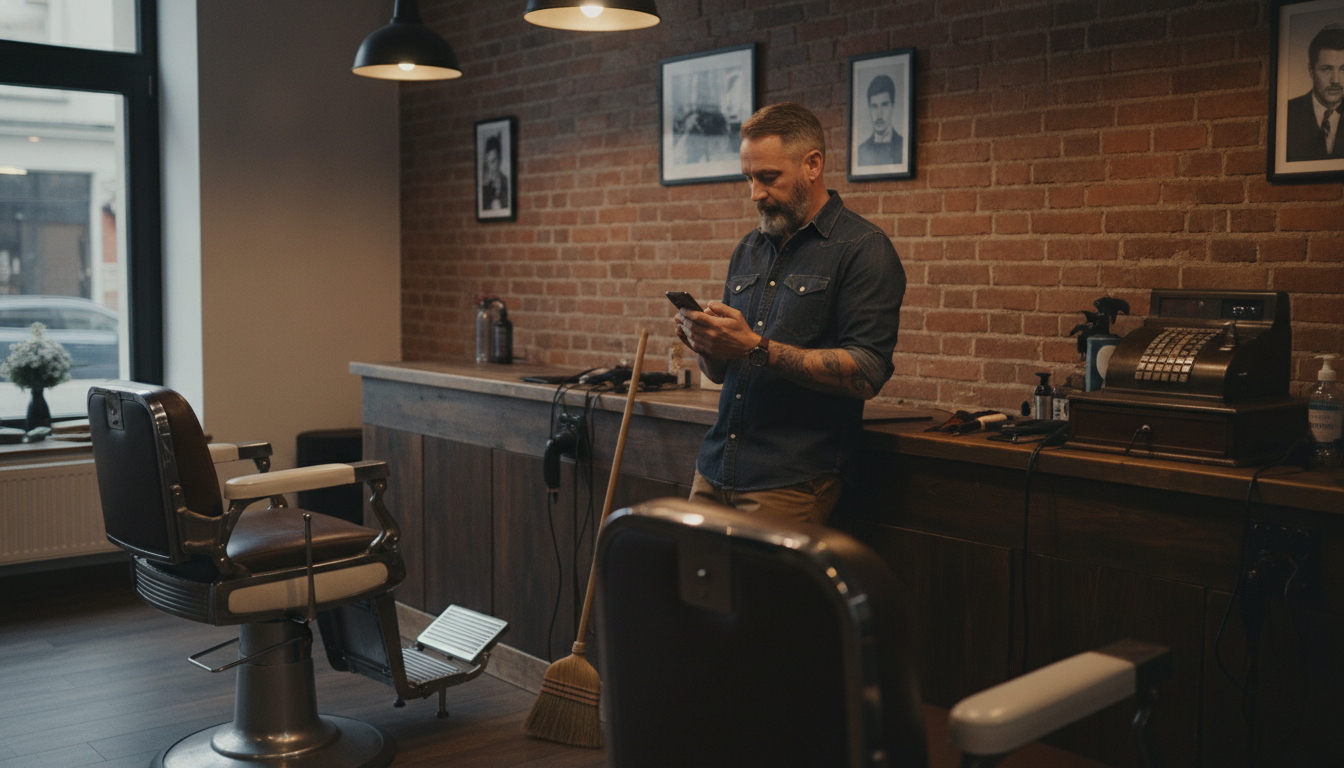
There is a barbershop owner in Bristol who posted on Instagram four times a week for a year, burned through three months of content ideas by February, and still had half-empty Thursday slots by summer. Three streets over, another shop posted three times a week - sometimes two - but every post had a clear point, landed at the same time each week, and spoke directly to people within a ten-minute walk. By month six, that second shop had a Thursday waitlist. Volume was never the variable. Rhythm was.
Why the Daily Post Grind Was Never Built for You
The advice to post every day came from influencer culture - creators building global audiences on algorithmic reach, where raw output buys visibility. A local business is structurally different. Your total addressable audience is measured in streets, not cities. The person who could walk into your salon this Friday already follows you, or they never will because they live forty minutes away. Chasing reach with daily volume is the wrong game entirely. The metric that matters for a physical local business is not impressions. It is triggered intent - the moment a nearby person sees your content and thinks 'I should go there this week'.
For a local business, one post that makes a nearby customer think 'I need to book this week' is worth fifty posts that get likes from people who will never walk through the door.
The Frequency That Actually Works: What the Evidence Points To
Across independent restaurants, salons, retail boutiques, and service businesses, the posting frequency with the strongest correlation to real-world outcomes - bookings, walk-ins, calls - sits between three and five posts per week, not seven. Below three and you lose the habit-forming signal that keeps you front of mind. Above five and content quality almost always drops faster than reach grows. Three strong posts per week, published consistently for twelve weeks, outperform seven rushed posts per week almost every time. The word 'consistently' is doing serious work in that sentence - same days, roughly same times, for months. Not a sprint in January and silence in March.
- Post 3-5 times per week - not daily, not sporadically. Predictability trains your audience's attention.
- Fix two or three publishing slots and protect them like appointments - Tuesday morning, Thursday lunchtime, Saturday afternoon works well for most physical businesses.
- One post per week should be purely local and proximity-specific: neighbourhood shout-outs, nearby events, 'we're five minutes from the market' content.
- One post per week should be offer-adjacent without being salesy - a behind-the-scenes shot, a product story, a staff moment that reminds people you exist.
- One post per week should carry direct intent - a specific available slot, a limited product, a reason to act this week rather than 'sometime'.
- Repurpose relentlessly: a strong post from four months ago is invisible to 40-60% of your current followers. Refresh and repost high performers every 90 days.
- Skip a day without guilt - a missed Wednesday post recovered on Thursday costs you almost nothing. A three-week posting gap costs you everything.
The Weekly Rhythm Any Owner Can Actually Hold
Structure removes the daily decision of what to post - which is the real reason most local owners fall off the wagon. When you have a repeating weekly template, content creation drops from a creative exercise to a quick fill-in. The template below is not theoretical. It is the skeleton used by the local businesses that sustain consistent posting without a marketing team or a social media manager.

A Repeatable Weekly Content Template
Monday - Community anchor post: something hyper-local, a neighbourhood reference, a shout-out to a nearby business, a local event tie-in. This signals to the algorithm and your audience that you are embedded in a specific place. Wednesday - Value or story post: a process shot, a product origin story, a customer transformation, staff content. No call to action needed. Thursday or Friday - Intent post: a specific available appointment, a product arriving this weekend, a meal deal running Friday only. One clear, low-friction next step. That is three posts. If capacity allows, add a Saturday story or quick reel. That is four. Never feel obligated to go to five. The goal is a rhythm you can sustain for eighteen months, not a sprint you can sustain for eighteen days.
How to Hand This Off Without Losing the Voice
The biggest risk when an owner systematises their content is that it starts sounding like a brand and stops sounding like a person. Your regulars follow you partly because of you - the texture of how you talk about your business matters. The way to hand off or automate without losing that is to build a voice document before you hand anything over: three sentences about how you speak (direct, warm, a little dry - whatever fits), five words you never use, and two or three example posts that felt right. Feed that context into any AI tool you use - including the content workflows inside Rulrr - and the output stays recognisably yours rather than sounding like a press release. Automation should accelerate your voice, not replace it.

Rulrr is built around exactly this principle - a business owner's POS data, past content, and local context feeding into AI-assisted content creation that runs on a schedule, not on willpower. The point is not to remove you from your marketing. It is to remove the friction that causes the three-week gaps that quietly cost you regulars. A repeatable weekly rhythm, batched in one sitting, scheduled in advance, built on a template your business actually fits - that is the system the barbershop in Bristol runs. Not viral. Not daily. Just consistent, local, and intentional.
The best posting schedule is the one you can still be running in month fourteen without dreading Monday morning.
Start This Week, Not Next Quarter
Pick three days. Lock in the times. Write the next two weeks of posts in one sitting - six posts total, two per slot. Publish the first one today. That is the entire setup cost of a system that, if you hold it, will do more for your foot traffic in six months than any daily posting sprint ever did. The owners who grow steadily are almost never the ones who post the most. They are the ones who showed up in the same place, on the same days, saying something worth reading - for long enough that their neighbourhood started to rely on it.